

A low-histamine diet is not a diet for life
First you cut out wine and aged cheese. Then tomatoes, several kinds of fruit, and eventually anything you are unsure about. Your food choices keep shrinking. A different approach may help: a low-histamine diet should have a plan, regular reviews, and a route back to a more varied way of eating.

A guideline from German, Austrian and Swiss allergy societies describes three stages: a short initial restriction, targeted food reintroduction, and an individual long-term diet. It suggests approximately 10–14 days for the first stage and up to six weeks for the testing stage. The long-term aim is adequate nutrition, a good quality of life, and only those restrictions that are justified for the individual.
Before you cross another food off the list
Symptoms after eating deserve attention. They do not, by themselves, establish histamine as the cause. Flushing, itching, diarrhoea and abdominal pain can have several explanations. The guideline therefore starts with assessing other possibilities, including food allergy, coeliac disease, some bowel diseases and carbohydrate malabsorption. A low blood DAO result does not establish the diagnosis either; this guideline states that measuring serum DAO activity has no diagnostic value.
Improvement after changing your diet also needs careful interpretation. If you change portion sizes, meal composition and alcohol intake at the same time, you cannot tell which change helped. Feeling better is useful information, but it is not independent proof of histamine intolerance. That is one reason to follow the initial restriction with a structured expansion of your diet.
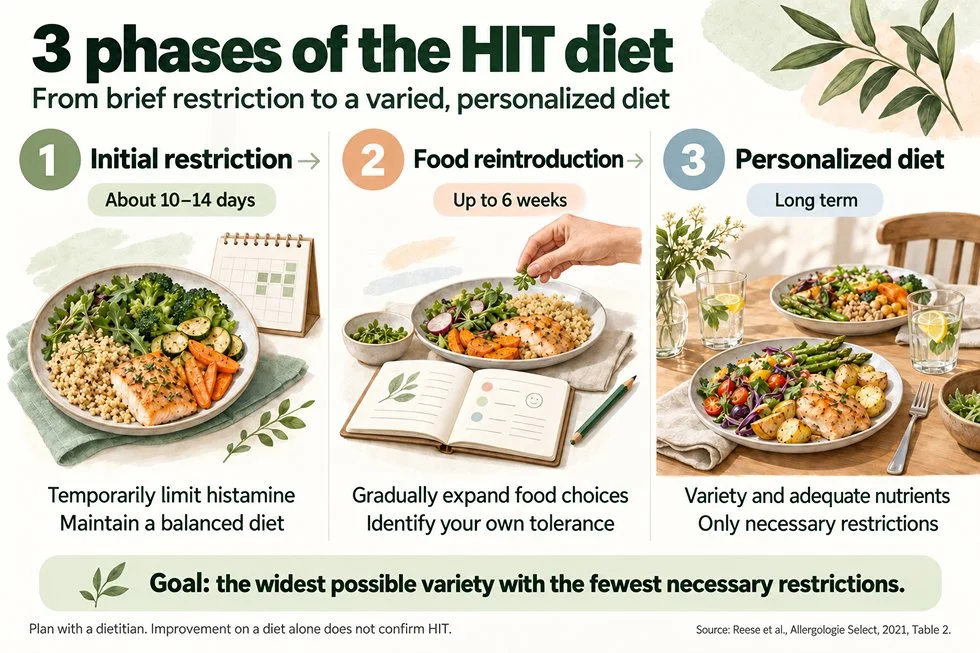
1. A short restriction phase: establish a useful starting point
The first approximately 10–14 days are intended to reduce symptoms and make eating patterns easier to assess. The guideline describes a mixed diet with an emphasis on vegetables and reduced intake of biogenic amines, especially histamine. Attention to meal composition and adequate nutrients is part of the approach. Meals should remain nourishing even while the selection is temporarily narrower.
Choose the specific adjustments with a dietitian, taking your usual diet, symptoms and any other diagnoses into account. Reviewing aged or fermented products and alcohol may be a practical starting point. This does not mean automatically removing entire food groups. If you have consistently eaten a particular food without problems, a red mark on an online chart is not sufficient reason to ban it permanently.
At the beginning, set a review date and decide what you will observe: for example, the frequency of diarrhoea, the severity of itching or abdominal pain. Briefly record portion sizes and when symptoms occur as well. The aim is to create a useful comparison. There is no need to weigh every mouthful or constantly check for symptoms.
If there is no convincing improvement by the end of this phase, a stricter diet is not automatically the next step. Review with a professional whether restriction is helping and whether another cause needs investigating. Even when symptoms improve, a temporary eating pattern should not drift into a months-long routine without a plan for what follows.
2. Food reintroduction: find out what you actually tolerate
The guideline allows up to six weeks for the testing phase. Its purpose is to broaden food choices and explore individual tolerance. It does not mean staying on the strict initial diet for another six weeks. Instead, suspected foods are deliberately reintroduced and unnecessary restrictions are gradually relaxed.
A practical way to make observations easier to interpret is to change one thing at a time while keeping the rest of the meal familiar. Choose a food whose return would make daily life easier or improve dietary variety. Agree an appropriate amount and pace with your professional. Starting with a smaller portion and increasing it later may sometimes be appropriate, but the guideline does not provide a universal schedule for everyone.
Record what you ate, the approximate amount, and any symptoms together with their timing. Notes about stress, menstruation, alcohol or medication changes can also be useful. The guideline takes these circumstances into account, although recording them does not establish causation. Do not stop or change prescribed medicines for a dietary trial without discussing it with your doctor.
One uncomfortable experience does not necessarily justify a lifelong ban. The circumstances need to be reviewed, and any further trial should reflect the severity of the reaction. Do not retry a food at home if it is associated with suspected allergy or a serious reaction, such as breathing difficulty or collapse. These situations require medical assessment. This approach is also not an invitation to perform home challenge tests using pure histamine.
Our Histamin.io diary can help you keep track as you reintroduce foods. Record meals, reactions and relevant circumstances, such as stress, sleep or your menstrual cycle, in one place. You can then revisit your notes when comparing days or discussing your experience with a dietitian. Open the diary and start by recording today’s meal. Sign-in is required.
Imagine adding a favourite ingredient back into a lunch whose other components you tolerate well. If the trial goes comfortably according to your agreed plan, you gain another usable food option. If the result is unclear, record that uncertainty instead of making a quick judgement. That note is more useful than a permanent ban based on uncertainty.
Discovering that an earlier restriction was unnecessary is a successful outcome. Priority can go to ingredients you use in cooking, foods you share with your family, or something that makes breakfast and a packed lunch easier to organise.
3. Long-term eating: adequate nutrition and room for everyday life
The third stage is not a single low-histamine menu that everyone must follow. It builds on what you and your professional have learned. Some foods may fit into everyday meals; for others, a smaller amount or a particular preparation may work better. Restrictions that have proved unnecessary do not need to stay simply because you have become used to them.
Nutritional balance cannot be judged by counting the foods on an approved list. What matters is whether your diet provides enough energy, protein and other nutrients. If you leave out an entire food group, its nutritional contribution needs replacing. A long-term plan must also fit your budget, working hours and cooking facilities. Enjoyment, shared meals and being able to visit friends without complicated negotiations belong in that plan too.
It can help to keep a few reliable meals and gradually expand their variations. At a planned review, discuss symptoms alongside any unintentional weight loss, skipped meals or increasing fear of food. If your diet remains very narrow, reconsider its benefits and the next steps with a professional.
Why an online chart cannot decide for you
The histamine content of food varies with maturation, processing and storage. Two products with the same name may therefore contain different amounts. The guideline also challenges restrictions based on so-called histamine liberators: it reports no reliable evidence for their existence in foods or their clinical significance in this context.
A list can prompt a discussion, but it cannot predict your personal response or replace a medical assessment. Searching for one perfectly accurate chart can distract from a more useful question: which specific adjustments help you feel better while still allowing you to eat comfortably and adequately?
Treat 10–14 days and up to six weeks as a suggested clinical framework. They are neither a promise of recovery nor a deadline for tolerating every food. This is an S1 guideline based on expert consensus, and its authors acknowledge limited and conflicting evidence. Some people may continue to need targeted long-term adjustments; others may return to an unrestricted diet. The purpose of the process is to find out what you need and gradually let go of restrictions that serve no useful purpose.
Scientific source: Reese I. et al. Guideline on management of suspected adverse reactions to ingested histamine. Allergologie Select, 2021; 5:305–314. Table 2: the three dietary phases and their duration. This is a reader-friendly adaptation; practical examples are not a verbatim protocol from the guideline. Illustrations created using AI.