

Cheese, Salami, Wine: Why Histamine Food Charts Disagree
Try it yourself: Google a chart of histamine in foods and open three different links side by side.

Emmental will be in the red category on one list, orange on the second, and completely missing from the third. A tomato will be listed as a histamine liberator in one place, but a completely neutral food in another. Yeast will be banned practically everywhere, even though it contains virtually no histamine.
This isn’t negligence on the authors' part. The truth is that such a chart cannot work in principle, and it’s worth knowing why—because it leads to a very practical conclusion.
Jaw-Dropping Numbers
The German clinical guideline for reactions to ingested histamine provides the measured ranges for two specific foods. These are by far the most telling numbers in the entire debate:
Emmental: Measured values range from less than 0.1 to 2,000 mg/kg.
Smoked mackerel: Measured values range from less than 0.1 to 1,788 mg/kg.
The difference between the lowest and highest measured sample of the exact same food is twenty-thousand-fold. One block of Emmental is as clean regarding histamine as a glass of water, while another, with the exact same name on the label, contains 40 times the dose considered safe for a healthy human by the EFSA.
This is no exception:
Spanish retail data: Shows values up to 389 mg/kg in cheeses and up to 475 mg/kg in fermented salamis.
Canned fish: Samples exceeded 650 mg/kg, with European data recording an extreme peak of over 8,900 mg/kg.
How can a single row in a chart describe this? "Emmental: 0.1 to 2,000 mg/kg"? Such information is completely useless.
Where the Variation Comes From
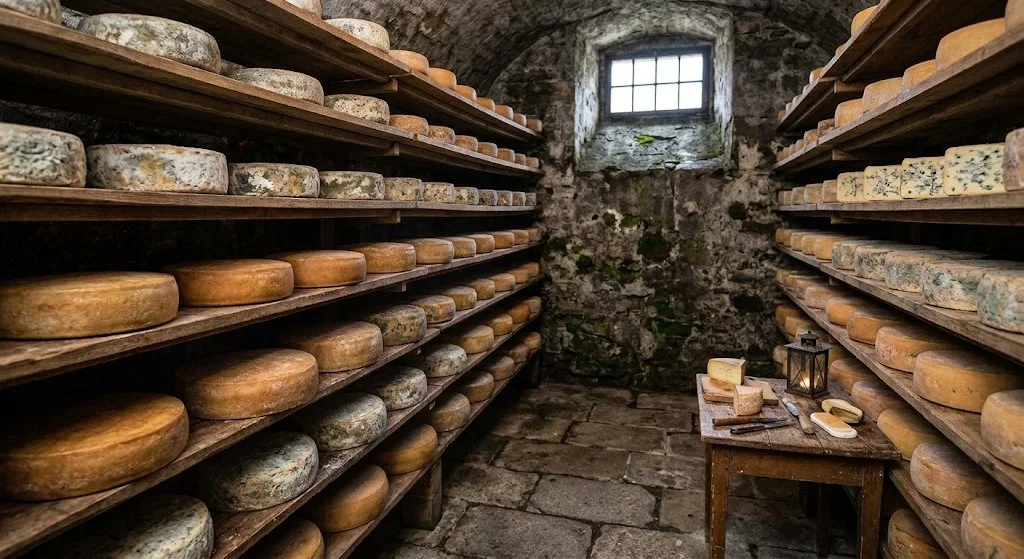
Fermented foods share one key trait: we intentionally let microorganisms work in them, as that’s the entire point of making cheese, salami, sauerkraut, or wine. Alongside desirable compounds, some of these microorganisms can also produce biogenic amines.
Whether and to what extent this happens depends on several variables that differ between two seemingly identical products:
Raw Material Quality & Freshness: Milk or meat with a higher initial microbial load introduces unwanted bacteria into the process.
Bacterial Strains: Not every strain of lactic acid bacteria produces amines. Industrial producers using selected starter cultures maintain good control over this, whereas traditional production relying on spontaneous fermentation inherently lacks it.
Aging Duration: Amines accumulate over time; an aged cheese simply has more time to form them than a fresh one.
Environmental Parameters: Temperature, salt content, pH, and packaging atmosphere constantly shift the balance between amine-producing and non-producing microbes.
Two cheeses of the same type, from two different manufacturers or batches, can be completely different foods from a histamine perspective. The name on the label tells you nothing, and the category "hard aged cheese" in a chart tells you even less.
What About Wine and Beer?
The news here is somewhat better. Fermented beverages contain significantly less histamine than solid fermented foods, with values in wine and beer typically being much lower.
Yet wine remains one of the most frequently cited triggers for symptoms. Reactions have been observed after ingesting as little as 50 micrograms of histamine in wine - a dose a thousand times smaller than what you might find in a piece of aged cheese.
Frankly, we don’t fully understand this yet. Multiple factors are likely at play:
Alcohol itself inhibits the activity of the DAO enzyme.
Wine contains other biogenic amines and phenolic compounds.
Absorption from liquids occurs differently than from solid food.
Whatever the explanation, it’s further proof that a simple number in a chart is insufficient.
Charts Also Ban Foods That Contain No Histamine
Beyond the variance issue, circulating low-histamine diets suffer from a second flaw highlighted by German guidelines: many ban foods containing no histamine at all—yeast being a prime example. They also rely on the concept of "histamine liberators"—foods supposed to trigger the release of the body's own histamine stores.
While this concept has some basis for a few specific substances, reliable evidence is lacking for most items found on these lists. Nevertheless, the lists keep spreading as they are copied from site to site without source verification.
This creates a diet that bans 50 foods, half of which have nothing to do with the problem. It may seem to work simply because the two or three actual trigger foods were eliminated along the way. The price paid, however, is disproportionate: a restricted diet, social isolation around food, and in some cases, nutritional deficiencies.
What to Do Instead
Expert consensus is surprisingly uniform on this topic, directly contradicting common internet advice:
Rule Out Other Causes: Exclude allergies, celiac disease, inflammatory bowel disease (IBD), or irritable bowel syndrome (IBS). Many conditions cause similar symptoms, and several are treatable.
Keep a Food and Symptom Diary: Boring, but it is the only tool that captures your specific individual reactions and accounts for time lags (which with histamine are often shorter than expected).
Follow a Targeted, Three-Phase Plan (Not a Permanent Diet):
A short, strict elimination phase.
A controlled reintroduction of foods.
A personalized, long-term diet tailored to your actual findings.
The goal is the broadest possible diet that doesn't cause symptoms—not the strictest one.
Keep in mind that tolerance fluctuates. The exact same cheese might bother you one day and not the next. That doesn't mean you were wrong—it might have simply been a different cheese.
Bottom Line
A histamine chart won't tell you how much histamine is in your food. It only tells you how much someone measured once in something that shared the same name. That is a very weak reason to ban cheese for five years.
Sources
Reese I. et al. German guideline for the management of adverse reactions to ingested histamine. Allergo Journal International, 2017. https://doi.org/10.1007/s40629-017-0011-5
Comas-Basté O. et al. Histamine and Other Biogenic Amines in Food. From Scombroid Poisoning to Histamine Intolerance. Biogenic Amines, IntechOpen, 2019. https://doi.org/10.5772/intechopen.84333
Motarjemi Y. (ed.). Encyclopedia of Food Safety. Academic Press, 2014. https://books.google.cz/books?id=mX1XAQAAQBAJ