

Medicines and dietary supplements for histamine intolerance: what helps and what harms
Histamine intolerance (HIT) is an increasingly common topic in modern society. Although most recommendations revolve around a low-histamine diet and food freshness, commonly used medications and dietary supplements also play a vital (and often neglected) role.

This important fact is pointed out by both professional texts pharmacy Dr. Max and specialists in nutrition and integrative medicine from the portal BrainMarket.
Many medicines for pain, cough or high blood pressure work as so-called DAO (diamine oxidase) enzyme blockers, which have the task of breaking down histamine in the body. On the other hand, as the experts add, properly chosen food supplements can significantly help the body with the processing of histamine.
In this article, we will look at which products to avoid during HIT, what to have in the medicine cabinet in case of a cold, and which food supplements are proven to help.
1. How does the body deal with histamine? (DAO vs. HNMT)
Histamine is essential for our body because it is involved in the immune response, the production of gastric juices and functions as a transmitter of impulses in the nervous system. The problem arises when more histamine accumulates in the body than the body can break down.
Two main enzymes designed to degrade histamine work in the human body:
- DAO (Diamine Oxidase): It works primarily in the digestive tract, where it breaks down histamine received from the diet.
- HNMT (Histamine-N-methyltransferase): Acts inside the cells, especially in the nervous system and lungs.
The imbalance can be caused by an increased amount of histamine in food, substances that block the enzyme DAO, or excessive flushing of histamine from mast cells by certain drugs - these substances are called histamine liberators.
The good news is that HIT does not have to be a permanent condition: acquired DAO deficiency may only be transient, and thus, by stopping DAO blockers and treating the cause (eg lactose intolerance), improvement or cure may occur.
2. Dangerous drugs for HIT
A number of common drugs either directly block the DAO enzyme or stimulate immune cells to massively release their own histamine into the bloodstream. At the same time, it is important to remember that all the drugs mentioned are only potential triggers - if you are already taking them and your body tolerates them, then continue taking them, because everyone can react to them individually. Always consult your doctor before stopping any prescribed medication.
A) Pain and anti-inflammatory drugs (NSAIDs)
This is a very commonly used group of drugs that block the DAO enzyme and can cause a severe adverse reaction in patients with HIT.
Risk active substances include:
- Ibuprofen (e.g. contained in the preparations Ibalgin, Brufen or Nurofen)
- Acetylsalicylic acid (Aspirin, Acylpyrin)
- Diclofenac (Voltaren, Veral)
- Naproxen (Nalgesin)
- Metamizol (often part of drops Algifen)
B) Medicines for coughs (Expectorants and mucolytics)
For a wet cough, people often turn to medicines to thin the mucus. However, pharmacists warn that some of the most common preparations are unsuitable for people with HIT because they block DAO or stimulate the release of histamine.
Risk active substances:
- Ambroxol (e.g. contained in the drugs Ambrobene, Mucosolvan, Halixol)
- N-acetylcysteine / NAC (e.g. ACC, Solmucol)
C) Other risk groups of drugs
Risk groups also include non-steroidal anti-inflammatory drugs, certain antidepressants, antiarrhythmics, antibiotics and some antihypertensives. A lack of copper, vitamin C and B6 also adds to these factors, as copper and vitamin C are crucial components of the DAO enzyme itself.
3. First aid kit guide for HIT: What to take for colds and pain?
If you get a cold, cough, temperature or toothache, you don't have to suffer. As stated in his consultation BENU pharmacy, you can choose safer alternatives that do not interfere with histamine.
Symptom | ❌ Unsuitable drugs (Avoid) | ✅ Suitable alternatives (Safe for HIT) |
Fever and pain | Ibuprofen, Aspirin, Diclofenac, Algifen | Paracetamol (Paralen, Panadol). Although not anti-inflammatory, it does not block the DAO enzyme. |
Dry cough | Ambroxol (Mucosolvan), NAC (ACC) | Bromhexine (Bromhexine) or Erdosteine (Erdomed). Herbal syrups are suitable for example Stopkašel or Sinupret. |
Crysis and stuffy nose | Classic drops with synthetic substances (in case of overuse) | Sea water or local antihistamines in drops/sprays. |
Allergic reaction / HIT attack | – | Antihistamines 2nd and 3rd generation (Zyrtec, Zodac, Claritine, Xados, Analergin) |
If they are used in the process of elimination diets, they will complicate the entire diagnosis in an absolutely fundamental way. Therefore, use them specifically for acute problems, not long-term.
4. Dietary supplements that are proven to help with HIT?
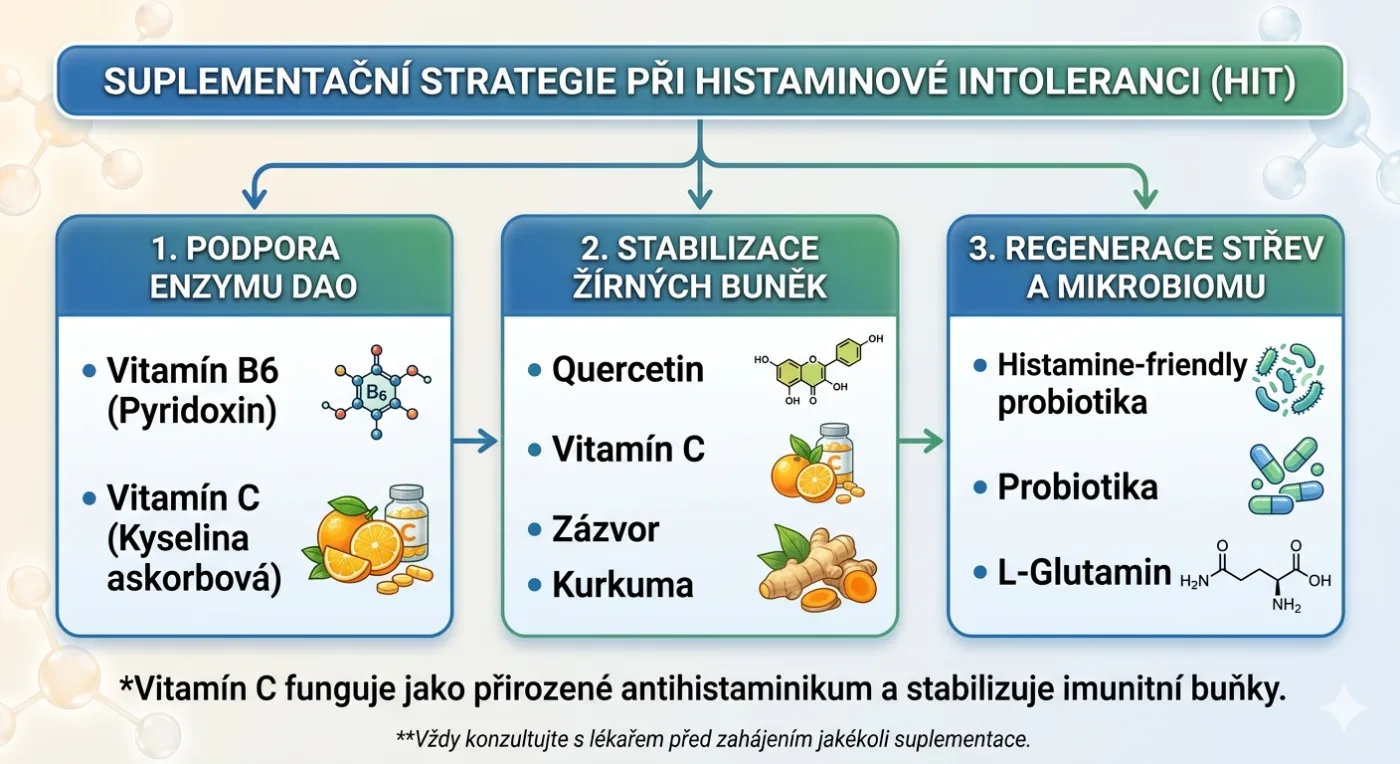
Supplementation focuses on three main pillars for histamine intolerance: support of the DAO enzyme, stabilization of mast cells (from where histamine is released) and healing of the intestinal mucosa.
Vitamin B6 (Pyridoxine)
Vitamin B6 is a key cofactor of the DAO enzyme – without sufficient B6, the enzyme in the body cannot function properly. For the best absorption, the active form (P-5-P) is recommended.
Vitamin C (Ascorbic acid)
Vitamin C helps accelerate the breakdown of histamine and at the same time stabilizes immune cells. A non-acidic form (e.g. sodium ascorbate) that does not irritate the stomach is ideal for HIT patients. The importance of vitamin C for stabilizing immune cells is also confirmed by newer pharmacological studies (Ang et al., 2018; Lykkesfeldt et al., 2025).
Riboflavin (Vitamin B2)
Supports metabolic processes associated with the processing of histamine and contributes to the regeneration of mucous membranes (Suwannasom et al., 2020).
Active DAO enzyme in tablets
The food supplement with DAO enzyme is taken approximately 15 minutes beforefood containing histamine - the enzyme then acts directly in the intestine and breaks down histamine from food before it is absorbed into the bloodstream. As an example, we can cite the preparation Daosin. The therapy is considered to be an adjunctive treatment only and does not work the same for all patients. It is advisable to try it and monitor the effectiveness individually.
Quercetin (Quercetin)
A natural flavonoid acting as a stabilizer of mast cells – it helps prevent these cells from releasing histamine when irritated by stress or cold.
Probiotics for HIT: beware, they can also harm
The gut microbiome fundamentally affects the overall histamine load in the body. Common probiotics can cause problems with HIT because some bacterial strains produce histamine themselves.
- ❌ Unsuitable strains (produce histamine): Lactobacillus bulgaricus, Lactobacillus casei, Lactobacillus reuteri
- Safe strains: according to studies, strains of Lactobacillus rhamnosus and Bifidobacterium animalis ssp. were able to reduce histamine release. Bifidobacterium infantis and Lactobacillus plantarum are also neutral.
Always choose probiotic complexes labeled as "low-histamine" or "histamine-friendly".
Natural anti-inflammatory substances
In order to calm the immune system in general, it is recommended to include ginger, turmeric or drink rooibos tea in the diet, which have natural anti-inflammatory and antihistamine effects.
5. Summary: How to proceed safely?
- Check your first-aid kit: Limit the use of Ibuprofen, Aspirin and medicines with Ambroxol.
- When in pain, reach for Paracetamol, when wet cough up Bromhexine or Erdostein.
- Support the body with supplementation: Vitamin C, vitamin B6 and specific low-histamine probiotics form the basis.
- Follow a low-histamine diet – that is the most effective step of all.
- Consult changes: Always consult your doctor before stopping any prescription medication.
Resources
- Dr. Max Lékárna: Histamine intolerance - symptoms, treatment and food table — general basis of the article
- BENU Pharmacy: Histamine intolerance - manifestations, diagnosis and treatment — cited in section 2 (NSAID warnings) and section 4 (probiotic strains)
- BrainMarket: How to grow old on histamine and why go to probiotics — general basis of the article
- A Spoon of Histamine: What is histamine intolerance — cited in section 1 (transient acquired DAO deficiency)
- Viscojis: Histamine intolerance — quoted in section 1 (histamine liberators)
- Zdravovek: Histamine intolerance - treatment in 4 steps — cited in section 2 (drugs as only potential triggers)
- Macromo: Histamine intolerance — cited in section 2C (risk groups of drugs)
- Daflex System: Histamine intolerance - nutritional therapy — cited in section 2C (deficiency of copper, vitamin C and B6)
- ATAC courses: Histamine intolerance — cited in section 3 (note to antihistamines)
- Florence: Histamine intolerance — cited in section 4 (DAO supplementation as adjunctive treatment)
- Moje Ambulance: Histamine intolerance: Manifestations, causes and diet — cited in section 4 (effectiveness of DAO supplementation)
- Fuchs M. Histamine intolerance. Medicína pro praxi, 2024;21(1):18–25 — general expert background of the article
- Hakl M. et al. Histamine intolerance. Internal Medicine, 2023;69(1):37–40 — cited in section 4 (complementary nature of therapeutic options outside the diet)
- Ang, A. et al. (2018). Vitamin C and immune cell function in inflammation and cancer. Biochemical Society Transactions, 46, 1147–1159. DOI: 10.1042/BST20180169 — cited in Section 4 (Vitamin C)
- Lykkesfeldt, J. et al. (2025). The pharmacology of vitamin C. Pharmacological Reviews, 77(2), 100043. DOI: 10.1016/j.pharmr.2025.100043 — cited in section 4 (vitamin C)
- Suwannasom, N. et al. (2020). Riboflavin: The Health Benefits of a Forgotten Natural Vitamin. International Journal of Molecular Sciences, 21