

A healthy person, poisoning, intolerance: Three different states that get confused
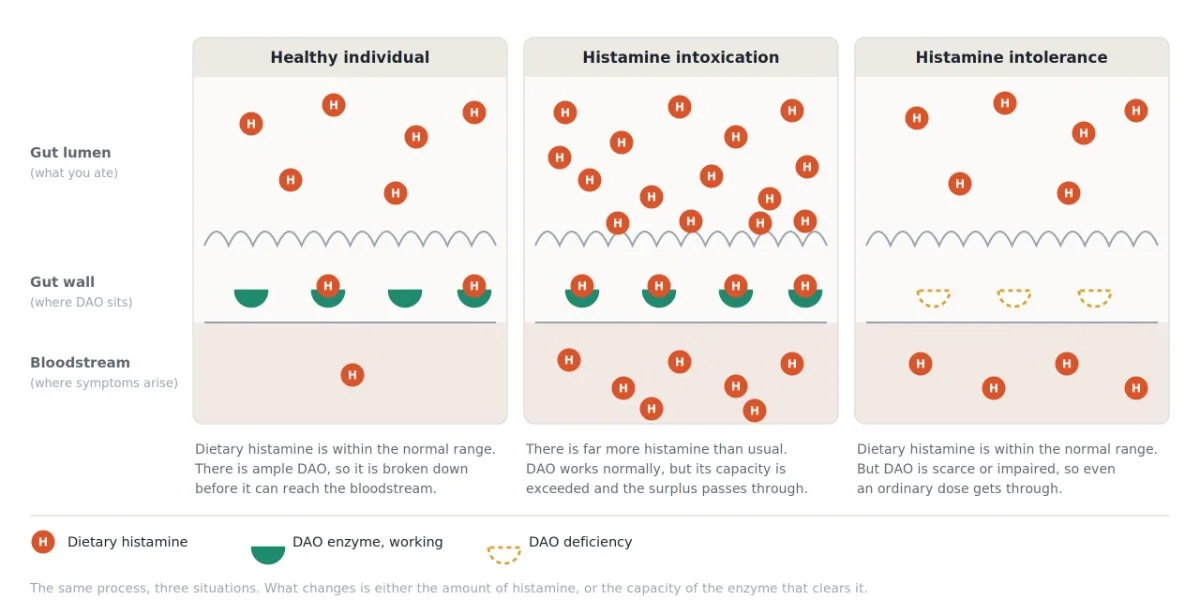
There is a single image that says more about histamine than a long explanation. It features three side-by-side panels: a healthy person, histamine intoxication, and histamine intolerance. The same process unfolds in all three, just with different numbers. Once you understand it, much of what is written about histamine on the internet stops making sense.
What happens in the gut of a healthy person
Histamine enters the body through two pathways. One we manage ourselves, as it is a common signaling substance used by the body during inflammation, in regulating stomach acid production, and within the nervous system. The second pathway is through food.
This is where the enzyme diamine oxidase comes in, usually abbreviated as DAO. It resides in the mucosa of the small intestine and acts much like a customs checkpoint. It breaks down dietary histamine before it can pass through the intestinal wall into the bloodstream.
In the first panel, that is exactly what it looks like. There are a few histamine molecules in the gut, plenty of enzymes, and the amount that reaches the bloodstream is negligible. No symptoms. This happens every time you eat a piece of cheese or drink a glass of wine without even realizing it.
The European Food Safety Authority estimates that a healthy adult can handle about 50 mg of histamine in a single meal without issue. A standard portion of fresh food will not come anywhere close to that amount.
Panel two: Poisoning
Now imagine that instead of fifty histamine molecules in your food, there are fifteen hundred. The amount of DAO enzyme remains the same—represented by those same green arches in the picture—but it simply cannot handle such a surge. Its capacity is exhausted, the remaining histamine passes into the blood, and it begins doing what histamine in the blood does: dilates blood vessels, irritates nerve endings, and increases capillary permeability.
The onset is fast, usually occurring within minutes to two hours. The face and neck flush, you feel hot, your heart races, your head aches, and you may develop hives, nausea, or diarrhea. Most people recover within four to six hours.
Technically, this is called histamine intoxication, though in practice you will more often hear it referred to as scombroid poisoning—that is, poisoning from spoiled fish.
Crucially, this can happen to anyone. You do not need a underlying disorder, a genetic mutation, or a diagnosis. If you eat enough histamine, you will get sick, no matter how healthy you are. It is poisoning in the same sense as mushroom poisoning, just with a different molecule.
However, because the symptoms resemble an allergic reaction, many people leave the doctor's office convinced they are allergic to fish. They aren't. The fish just spent too long in the heat.
Panel three: Intolerance
The final panel is the most interesting, as a completely different variable changes here.
The amount of histamine in the food is normal—a level a healthy person wouldn't even notice. But the DAO enzymes are drawn in yellow instead of green. There are too few of them, or they aren't working as they should. The customs checkpoint is understaffed, so the same amount of histamine that previously passed without consequence now leaks into the bloodstream.
Symptoms are often similar to those of poisoning, though usually milder, more insidious, and harder to link to a specific food. Headaches, bloating, diarrhea, nasal congestion, hot flashes, fatigue, and in some people, hives or worsened menstrual cramps.
This condition is known as histamine intolerance, and it is estimated to affect roughly one percent of the population. It is a far rarer phenomenon than its prevalence in public discussion would suggest.
Why might someone lack sufficient DAO? There are several reasons: variants of the AOC1 gene, inflammatory bowel diseases that damage the intestinal lining, and quite frequently, medications—many commonly prescribed drugs inhibit this enzyme's activity. According to one review, about a fifth of people in Europe take them. Alcohol also plays a role.
What about allergies?
It isn't in the picture, but it belongs here because it is what gets confused most often.
A food allergy is an immune reaction. The body creates antibodies against a specific protein—for instance, a tuna protein—and upon the next encounter, triggers a cascade that releases histamine from mast cells. Hence the similarity in symptoms.
Yet the difference is fundamental. In an allergy, your own body produces histamine in response to a protein, meaning only the allergic individual reacts, and even trace amounts are enough. In intoxication, the histamine is already in the food, everyone reacts, and it depends primarily on the dose. In intolerance, the amount of histamine in the food is normal, but your body cannot break it down fast enough, so only a portion of people react, depending on both the dose and the individual.
In practice, this matters immensely. Someone with an allergy must avoid the food entirely and permanently, whereas someone who suffered fish poisoning doesn't need to avoid fish at all—they just need to ensure it is fresh. It makes a world of difference for quality of life.
How do you tell them apart?
Here comes the frustrating part: we do not yet have a reliable test for histamine intolerance.
The most commonly offered test—checking serum DAO levels in the blood—is considered useless for diagnosis according to German medical guidelines. The reason is simple: DAO resides in the intestinal mucosa, not in the blood, and serum levels tell us nothing about how the enzyme functions where it actually matters. The guidelines explicitly state that no objective biomarker currently exists for these reactions.
What is left to do? Rule out other causes (such as allergies, celiac disease, or intestinal disorders), keep a food and symptom diary, and take an individualized approach. This does not mean a long-term, strict elimination diet based on a downloaded list, but rather a brief, targeted phase followed by a structured reintroduction of foods. Professional guidelines strongly advise against strict elimination diets, as indefinite restriction needlessly reduces quality of life and strips essential nutrients from your diet.
The takeaway
The next time you come across an article about histamine, ask yourself a single question: Is it talking about the amount of the substance in the food, or the body's ability to process it?
Poisoning is a problem with the food, intolerance is a problem with the person, and an allergy is a problem with the immune system. They overlap only in how they manifest on the surface—and that is precisely why so much confusion has gathered around histamine.
Sources
The three-state diagram is based on the concept described in the following paper, though it is not a direct reproduction of its original figure:
- Comas-Basté O. a kol. Histamine Intolerance: The Current State of the Art. Biomolecules, 2020. https://doi.org/10.3390/biom10081181
Histamine and Other Biogenic Amines in Food. From Scombroid Poisoning to Histamine Intolerance. IntechOpen, 2019. intechopen.com/chapters/65545
Reese I. et al. German guideline for the management of adverse reactions to ingested histamine. Allergo Journal International, 2017. doi.org/10.1007/s40629-017-0011-5
U.S. Food and Drug Administration. Scombrotoxin Poisoning and Decomposition. fda.gov