

Try the new Diet Guide for a more varied diet
When you feel unwell after a meal, it can be tempting to cut out another food. The Diet Guide helps you keep track of what you eat and how you feel, and gradually bring back foods you miss. Find out how its three phases work and how to get started.
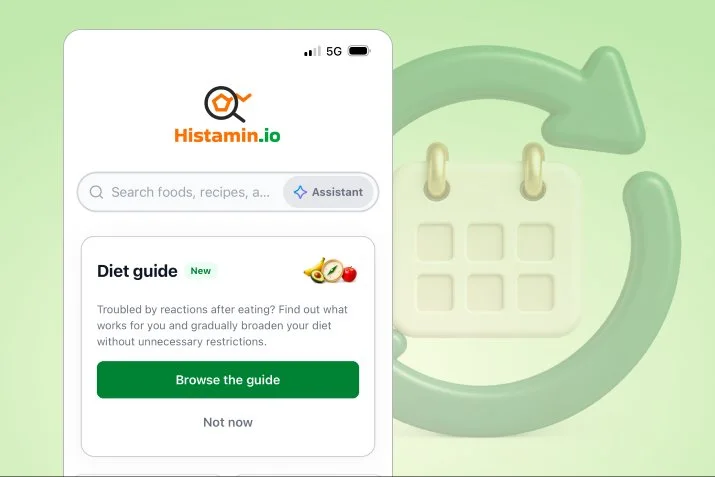
When your food choices keep shrinking
After an unpleasant reaction to a meal, it is understandable to want to avoid it happening again. You cut out one food, then another — and eventually find yourself eating the same few meals. Food ratings in a catalogue can offer a starting point, but they cannot tell you what you personally tolerate. [1]
The Diet Guide helps you gradually bring back foods you miss and work towards a more varied diet.
We explain why restriction should be temporary in A low-histamine diet is not a diet for life.
What the Guide adds to your Diary
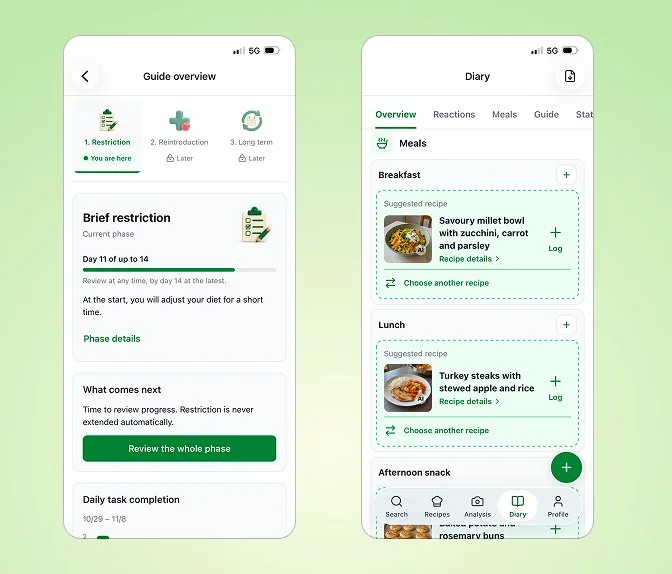
In the Diary, you record food, drinks and symptoms. The Guide shows which of the three phases you are in and what to focus on. It also offers daily tasks during the first two phases.
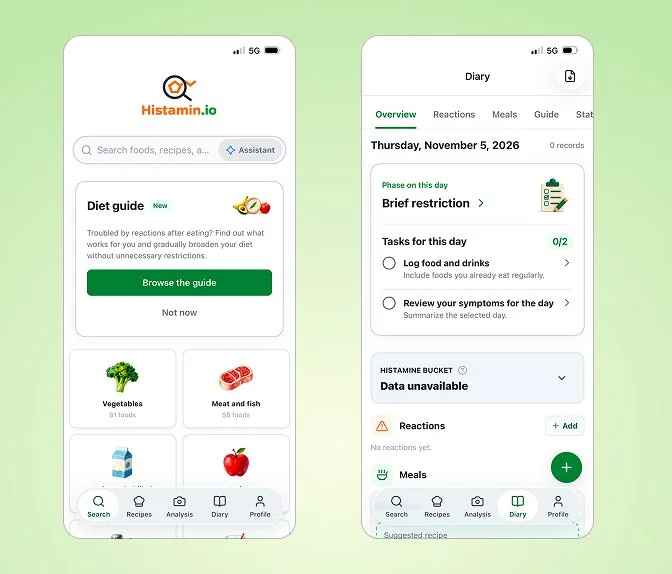
You can take your records to an appointment with a doctor or dietitian. [2] [1] For more on what records and tests can tell you, read Is there a reliable test for histamine intolerance?.
How the three phases work
The three-phase approach comes from a clinical guideline published in 2021. [3] Its entry is also available in the AWMF registry. [4] The Guide puts this general idea into practice through tasks and records in the app.
1. A short period of restriction
The first phase aims to ease reactions and other symptoms after meals by reducing histamine intake for a short time. You build meals around foods you usually tolerate well. Even with fewer foods to choose from, you still need to eat enough and keep as much variety as possible. [3]
When you review the phase, compare your Diary entries to see whether your symptoms have changed since the start.
If symptoms do not improve, discuss the next steps with a doctor or dietitian. Cutting out many foods for a long time can make it harder to eat enough and get all the nutrients you need. [1]
2. Bringing foods back
In the second phase, you gradually bring a range of foods back into your diet. Try them one at a time. Keep the rest of your meals familiar, using foods you usually tolerate. This makes your records easier to follow.
The Guide distinguishes between small and usual portions. For each, record how much you ate and how you felt in the Diary.
If symptoms appear, stop trying that food for now. Record them straight away, including when they started. One unpleasant experience does not necessarily mean you need to avoid that food forever. [2] [1]
Do not try a food again at home through the Guide if you have a known or suspected allergy to it, or if it was associated with a severe reaction, unless you have an agreed plan with a health professional. [5] [6]
3. A diet for everyday life
In the final phase, look back at what has worked for you. Which foods have you brought back? What do you regularly eat without symptoms, and where do you still need help deciding what to do next?
You can then work with a doctor or dietitian towards a diet with as much variety as possible that suits you. Each restriction should have a clear reason, and your diet should provide enough energy and nutrients for everyday life.
Who is the Guide for?
The Guide is intended for adults. If you are pregnant, have an eating disorder, are losing a significant amount of weight without intending to, already have a very restricted diet, or have a health condition that requires an individual diet, you cannot start the Guide. In these situations, seek individual support from a doctor or dietitian.
How to try the Guide
The Diet Guide is now available in the mobile app to all registered users with an active Premium plan. You’ll find it in the Diary, on the Guide tab.
If you don’t have Premium and would like to try the Guide, fill in the short registration form. We’ll email you with the details.
The Diet Guide does not replace a medical assessment or individual advice from a doctor or dietitian. Its specific tasks, portions and timing are not a clinically validated treatment protocol. Improvement after a dietary change or one symptom-free portion does not, by itself, establish the cause of symptoms, a diagnosis, or long-term tolerance. The app does not guarantee the safety of individual foods.
Sources
- Cooke Z, et al. Naturally Occurring Food Chemical Components and Extraintestinal and Gastrointestinal Symptoms in Adults: A Systematic Review. Clinical & Experimental Allergy. 2024;54:855–880. doi:10.1111/cea.14561.
- Clevers E, et al. Relations between food intake, psychological distress, and gastrointestinal symptoms: A diary study. United European Gastroenterology Journal. 2019;7:965–973. doi:10.1177/2050640619839859.
- Reese I, et al. Guideline on management of suspected adverse reactions to ingested histamine. Allergologie Select. 2021;5:305–314. doi:10.5414/ALX02269E.
- AWMF. Official record for guideline 061-030. The 2021 version was valid until 30 July 2026. The guideline is now being revised. Status checked on 8 November 2026.
- Santos AF, et al. EAACI guidelines on the management of IgE-mediated food allergy. Allergy. 2025;80:14–36. doi:10.1111/all.16345.
- Santos AF, et al. EAACI guidelines on the diagnosis of IgE-mediated food allergy. Allergy. 2023;78:3057–3076. doi:10.1111/all.15902.