

Gut Health and Histamine: Can Your Microbiome Affect Tolerance?
The gut plays an important part in histamine tolerance. Its lining produces DAO, while some bacteria can make histamine themselves. How do these processes connect, and what might they mean for everyday food tolerance?


The gut plays an important part in histamine tolerance. The intestinal lining produces DAO, an enzyme that helps break down histamine from food, while some gut bacteria can make histamine themselves [1] [2]. The condition of the lining and the activity of microorganisms therefore shape the environment in which the body encounters histamine.
The short answer: the microbiome is not the only possible contributor to symptoms, but it is an important part of the picture. Together with the intestinal lining, DAO, the amount of histamine in food and other circumstances, it may help explain why tolerance changes.
Three players at the gut barrier
When food reaches the small intestine, three important influences meet:
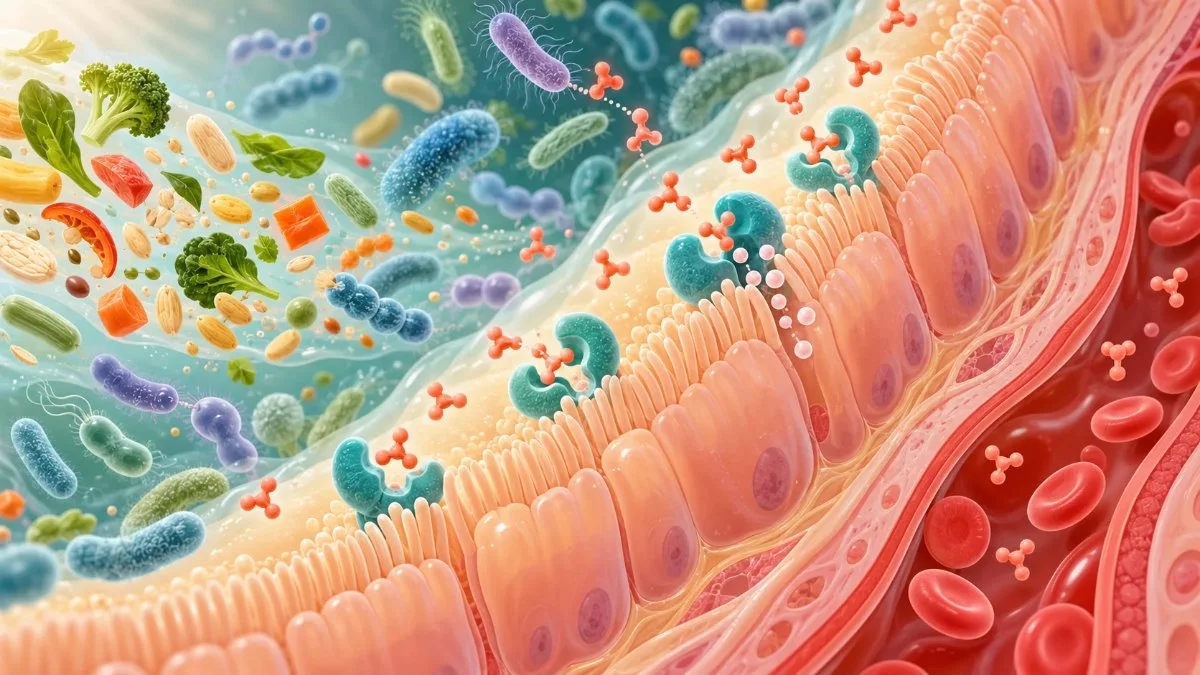
- Histamine in food. Its level often rises during ageing, fermentation or unsuitable storage [1].
- The intestinal lining and DAO. Diamine oxidase helps break down histamine before it enters the circulation. It is produced mainly by mature cells in the intestinal lining [6].
- Gut microorganisms. Some bacteria have an enzyme that converts the amino acid histidine into histamine [2].
These influences can add up during the day. Portion size, food freshness, alcohol, medicines, digestive health and the composition of the whole meal may all matter. This fits the idea of the histamine bucket: the same food may be better tolerated on one day than another.
The intestinal lining is more than a passive barrier
DAO is produced mainly by differentiated enterocytes, the mature cells that line the intestine. Here, it helps deal with histamine arriving from the contents of the gut. If the lining is inflamed or damaged, the way the intestine handles histamine may also change [6].
That is why persistent digestive symptoms deserve a broader view. Coeliac disease, inflammatory bowel disease, infections and other digestive disorders can affect the intestinal lining while causing symptoms that are easily attributed to histamine alone. Supporting gut health is not only about removing more foods; it also includes identifying and treating disease affecting the lining when it is present [6].
Some bacteria really can produce histamine
The ability to make histamine is not limited to one “bad” bacterium. A genomic study of more than 36,000 bacterial genomes identified putative histamine-production capacity in 117 species across several groups [2].
The exact strain matters. Bacteria belonging to the same species can differ in whether they carry the necessary genes and how actively they use them. The availability of histidine, the surrounding environment and the community of other microorganisms also affect the result. The microbiome cannot be reduced to simple lists of “good” and “bad” genera.
Bacterial histamine is not automatically harmful either. Histamine is a normal signalling molecule, and its local effect can differ according to the receptor and situation. The balance of the whole environment matters more than the presence of one microorganism [2].
What human studies suggest
Early human studies have repeatedly found differences between the microbiomes of people with symptoms attributed to histamine intolerance and comparison groups:
- A 2018 study reported lower microbial diversity and different proportions of some bacteria among eight people in its HIT group [3].
- A 2022 study compared 12 women with symptoms attributed to HIT and 14 healthy participants. The HIT group had more of several bacteria with putative histamine-producing capacity [4].
- A subsequent nine-month pilot involving five women recorded a reduction in some bacteria associated with histamine production during a low-histamine diet plus DAO supplementation [5].
Together, these findings support a connection between the intestinal environment and histamine tolerance. They have not identified one universal “HIT microbiome”, and they cannot yet show whether the differences caused symptoms, developed as a consequence of them, or partly reflected a long-term restrictive diet.
What you can influence in everyday life
- Pay attention to freshness and storage. In some foods, microorganisms create histamine during ageing, fermentation or unsuitable storage. Different examples of the same food may therefore contain different amounts [1].
- Address persistent gut symptoms. Recurrent diarrhoea, pain, marked bloating or unintentional weight loss deserve medical assessment. The aim is not to blame every symptom on the microbiome, but to avoid overlooking the condition of the intestinal lining.
- Protect dietary variety. A very narrow diet changes the nutrients available to gut bacteria. If you try a low-histamine restriction, it should include a review point and a route back to a broader diet. We explain this in more detail in A low-histamine diet is not a diet for life [5] [7].
- Observe your tolerance in context. Record not only the food, but also the amount, freshness, timing of symptoms, alcohol, medicines, recent infection or menstrual cycle. This can reveal recurring patterns without banning everything at once.
How to think about probiotics
Probiotics may be a useful way to influence the gut environment, but their properties are strain-specific. Two strains of the same species can behave differently, and a benefit shown for one strain cannot automatically be transferred to all its relatives [8].
Look for the full strain designation and a clear reason for taking the product. Introduce one change at a time and observe your response. If a product repeatedly makes symptoms worse, stop taking it and discuss the next step with a doctor or registered dietitian. The label “low-histamine probiotic” alone does not predict how a particular product will affect a particular person.
Where current knowledge ends
We know that the intestinal lining, DAO, microorganisms and histamine are biologically connected. We do not yet have one microbial profile that can identify the cause of an individual's symptoms or prescribe a universal treatment. This does not make the microbiome irrelevant; it means that microbiome findings need to be considered alongside symptoms, digestive health and the overall diet.
If you are interested in diagnosis, individual laboratory methods and what an allergist can investigate, see our separate article Is there a reliable test for histamine intolerance?
Key takeaways
- The gut actively influences how much histamine is produced and broken down in its environment.
- DAO is produced mainly by mature cells in the intestinal lining, while some bacterial strains can make histamine.
- Supporting tolerance involves more than food selection: freshness, dietary variety and persistent gut symptoms also matter.
- Probiotics should be considered by exact strain and individual response, not only by species name.
Important: This article is for education and does not replace individual diagnosis or treatment. Discuss persistent, severe or new symptoms with a healthcare professional.
Sources
- Comas-Basté O. et al. Histamine Intolerance: The Current State of the Art. Biomolecules. 2020.
- Mou Z. et al. The taxonomic distribution of histamine-secreting bacteria in the human gut microbiome. BMC Genomics. 2021.
- Schink M. et al. Microbial patterns in patients with histamine intolerance. Journal of Physiology and Pharmacology. 2018.
- Sánchez-Pérez S. et al. Intestinal Dysbiosis in Patients with Histamine Intolerance. Nutrients. 2022.
- Sánchez-Pérez S. et al. The dietary treatment of histamine intolerance reduces the abundance of some histamine-secreting bacteria of the gut microbiota in histamine intolerant women. Frontiers in Nutrition. 2022.
- Żybul P. et al. Diamine Oxidase and Gastrointestinal Diseases. Biomolecules. 2026.
- Reese I. et al. Guideline on management of suspected adverse reactions to ingested histamine. Allergology Select. 2021.
- McFarland L. V. et al. Strain-specific and disease-specific efficacy of probiotics. Frontiers in Medicine. 2018.